


Distinguished Microwave Lecturers (DMLs)
As every year, the newley elected class of Distinguished Microwave Lecturers (DMLs) will present in a special session on Monday.
Monday 08:00
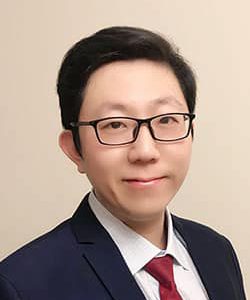
Artificial Neural Network Techniques for Microwave Computer-Aided Design
Feng Feng, School of Microelectronoics, Tianjin University, China
Abstract: Artificial neural network (ANN) techniques are important techniques for microwave computer-aided design (CAD) to perform forward/inverse modeling for active/passive components to enhance circuit design. With measured or simulated data of microwave devices, ANNs can be trained to learn relevant microwave relationships which are otherwise computationally expensive or for which efficient analytical formulas are not available. By training an ANN using data from electromagnetic (EM)/physics simulations, one can use the trained ANN as models for microwave devices to replace the EM/physics models, which are typically CPU-intensive, to significantly accelerate circuit design with EM/physics-level accuracies. ANNs can help address two of the frequently encountered challenges in microwave CAD: One is the computationally expensive challenge in forward modeling, and the other is the no-analytical-equation challenge in the inverse design. To improve the accuracy and reliability of ANN modeling and design optimization, the knowledge-based neural network (KBNN) has been developed. The knowledge-based approach combines neural networks with prior knowledge to build models. The neuro-TF modeling approach, which integrates neural networks with transfer functions, has emerged as an attractive candidate in EM parametric modeling in recent years. The ANN has also been trained to learn the complex and high-dimensional relationships between inputs and outputs in the inverse problems. The trained ANN models provide fast answers of EM/multi-physics behaviors of microwave components when geometrical parameters are repetitively changed and can be used in high-level design.
Speaker's Bio: Feng Feng received the B.Eng. degree in Tianjin University, Tianjin, China, in 2012, and the Ph.D. degree in the School of Microelectronics at Tianjin University, Tianjin, China, and the Department of Electronics at Carleton University, Ottawa, ON, Canada, in 2017. From 2017 to 2020, he was a Postdoctoral Fellow in the Department of Electronics at Carleton University, Ottawa, ON, Canada. In 2020, he joined the School of Microelectronics at Tianjin University, Tianjin, China, where he is currently a Full Professor. Dr. Feng has authored and co-authored over 200 IEEE journal and conference papers including over 50 IEEE TMTT papers. His research interests include electromagnetic parametric modeling and design optimization algorithms, deep neural network modeling method, space mapping algorithm and surrogate model optimization, electromagnetic centric multiphysics modeling and optimization, and quantum computing in computational electromagnetics. Dr. Feng is the Chair of the IEEE MTT-S Technical Committee on Design Automation (TC-2) and a member of the IEEE MTT-S Working Group on AI and Machine Learning Based Technologies for Microwaves in the MTT-S Future Directions Committee. He is the TPC Chair of the 2025 IEEE MTT-S International Conference on Numerical Electromagnetic and Multiphysics Modeling and Optimization (NEMO 2025). He was the General Chair of the 2021 IEEE MTT-S Young Professionals Workshop on Electromagnetic Modeling and Optimization (EMO 2021) and the General Co-Chair of the IEEE MTT-S Young Professionals Workshop on EMO from 2022 to 2024. He serves as an Associate Editor for IEEE MICROWAVE AND WIRELESS TECHNOLOGY LETTERS, a Guest Editor for IEEE TRANSACTIONS ON MICROWAVE THEORY AND TECHNIQUES of Special Issues of NEMO 2025, and a Guest Editor for IEEE MICROWAVE MAGAZINE of Special Issues of Young Professionals Workshop on EMO. He has been selected as an IEEE MTT-S Outstanding Young Professional Lecturer since 2025.
Monday 08:33
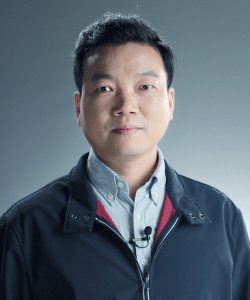
High-Efficiency and Large Dynamic Power Range Microwave Rectification in WPT
Changjun Liu, Sichuan University, China
Abstract: Microwave Wireless Power Transmission (MWPT) is a transformative technology that enables long-distance energy delivery for critical applications such as Space-Based Solar Power (SBSP), aviation power, and wireless sensor networks for the Internet of Things (IoT). To transition from laboratory concepts to ubiquitous real-world deployment, MWPT systems must overcome significant bottlenecks regarding rectification efficiency and operational adaptability. This lecture details advanced methodologies for achieving high-efficiency microwave rectification and extending the dynamic power range. We first address the limitations of conventional rectifier designs, which often suffer from large footprints and high insertion losses due to bulky band-pass filters. A novel topology is presented that utilizes a series band-stop structure—specifically a short-ended λg/8 transmission line—to facilitate effective harmonic recycling while significantly reducing the circuit size. Furthermore, maintaining high conversion efficiency under fluctuating input power levels is a major challenge for traditional rectifiers. By leveraging the nonlinear impedance characteristics of Schottky diodes and implementing adaptive impedance matching, we have developed power-adaptive rectifiers. These designs demonstrate an ultra-wide 31 dB power dynamic range (spanning from -1 dBm to 30 dBm). The lecture concludes with a forward-looking vision for MWPT’s future. We explore how these technical breakthroughs will enable global energy solutions through Solar Power Satellites (SPS), seamless consumer device charging, and powering humanoid robots in industrial environments. Attendees will gain a comprehensive understanding of how innovative circuit design is driving the evolution of microwave energy into a daily reality.
Speaker's Bio: Dr. Liu received the B.S. degree in applied physics from Hebei University, China, in 1994, and the M.S. degree in radio physics and the Ph.D. degree in biomedical engineering from Sichuan University, China, in 1997 and 2000, respectively. From 2000 to 2001, he was a postdoctoral researcher at Seoul National University, Seoul, South Korea. From 2006 to 2007, he was a visiting scholar at Ulm University, Ulm, Germany. Since 1997, he has been with the College of Electronics and Information Engineering, Sichuan University, where he has been a professor since 2004. He currently serves as Associate Dean of the College of Electronics and Information Engineering. He is a Senior Member of IEEE and the Chinese Institute of Electronics (CIE). From 2006 to 2010, he was recognized as an Outstanding Reviewer for the IEEE Transactions on Microwave Theory and Techniques. He has been recognized as an Academic and Technology Leader of Sichuan Province since 2023 and was selected for the New Century Excellent Talents Program of the Ministry of Education of China from 2009 to 2012. He serves as an Associate Editor of IEEE Microwave and Wireless Technology Letters and a Topic Editor of IEEE Journal of Microwaves. Dr. Liu has authored two books and published more than 200 papers. His current research interests focus primarily on microwave and millimeter-wave wireless power transmission. His research has covered frequencies ranging from S-band to X-band and wireless power transmission over distances ranging from meters to kilometers. He has also investigated wireless power transmission in enclosed cavities and developed microwave rectifiers with improved conversion efficiency and extended dynamic power ranges. Dr. Liu has served as the principal investigator for more than sixteen research grants funded by government agencies and industry, including six grants from the National Natural Science Foundation of China (NSFC).
Monday 09:06
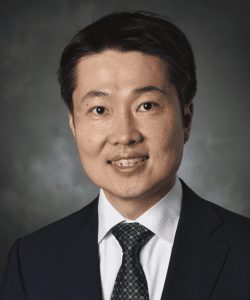
Toward Scalable Sub-THz Phased Array Transceivers: Key Challenges and Design Opportunities
Wooram Lee, University of Illinois Urbana Champaign
Abstract: The rapid growth of wireless data traffic, along with emerging applications such as VR/AR/XR, holographic telepresence, and real-time digital twins, is driving the demand for communication systems beyond 5G. Meanwhile, next-generation sensing systems for autonomous driving and industrial automation require sub-degree angular resolution to detect small targets in complex environments. Meeting these requirements of ultra-high data rates communications and ultra-high-resolution sensing motivates operation in the sub-THz spectrum, where wide bandwidths enable high throughput and fine range resolution, and short wavelengths support dense antenna integration. However, fully exploiting the sub-THz spectrum presents significant challenges. Severe free-space path loss limits communication and sensing range, while silicon transistors offer limited gain and output power near fmax. To address these constraints, large-scale phased-array transceivers become essential. With N-element transmit and receive arrays, coherent beamforming can ideally enhance the link budget proportional to N³, compensating for path loss and device limitations while enabling multi-beam MIMO operation. A critical bottleneck in realizing scalable sub-THz beamformers lies in antenna-in-package (AiP) integration. As frequency increases, the antenna pitch (λ/2) in uniform arrays shrinks, drastically reducing the area available for RFICs and imposing severe integration, routing, and thermal constraints. This lecture presents scalable design strategies for sub-THz phased arrays, emphasizing compact, power-efficient RFIC architectures. Highlighted examples include a calibration-free passive phase shifter offering precise, low-loss control at 140 and 240 GHz, and an ultra-compact 140-GHz bidirectional transceiver front-end that minimizes chip area and switching loss while maintaining competitive output power, efficiency, and noise performance. Together, these innovations pave the way for practical, scalable sub-THz phased-array systems for future communication and sensing networks.
Speaker's Bio: Wooram Lee is an Associate Professor of Electrical Engineering at University of Illinois Urbana Champaign. He received his B.Sc. and M.S. degrees in electrical engineering from the Korea Advanced Institute of Science and Technology (KAIST) in 2001 and 2003, and his Ph.D. degree at Cornell University in 2012. From 2015 to 2020, he was a Research Staff Member in the RF Circuits and Systems Group at the IBM T. J. Watson Research Center, where he was involved in the development of high-performance mmWave phased array circuits and systems, as well as high-speed serial link transceivers for optical communication. He was also an Adjunct Assistant Professor at Columbia University from 2017 to 2020. From 2012 to 2015, he was with Broadcom, CA, where he worked on multi-Gbps CMOS transceivers and data converters for broadband communication in optical, copper, and backplane applications. From 2003 to 2007, he was a research engineer at the Electronics and Telecommunications Research Institute (ETRI), Korea, working on optical transceivers and links. Prof. Lee serves as the Distinguished Microwave Lecturer (DML) of the IEEE Microwave Theory and Technology Society (MTT-S) for 2027-2029, an Associate Editor for the IEEE Transactions on Microwave Theory and Techniques, a Guest Editor for the IEEE Journal of Solid-State Circuits, and a member of the Technical Program Committee of the IEEE Radio-Frequency Integrated Circuits (RFIC) Symposium, the IEEE BiCMOS and Compound Semiconductor Integrated Circuits and Technology Symposium (BCICTS), and the International Microwave Symposium (IMS). He received the Best Student Paper Award (1st place, as a faculty advisor) from IEEE IMS 2026, the Best Student Paper Award (1st place, as a faculty advisor in 2023), and Best Industry Paper Award (in 2019) from IEEE RFIC Symposium, 2022 Asia-Pacific Microwave Conference (APMC) Prize (as a co-recipient), the IEEE Solid-State Circuits Predoctoral Fellowship (the sole winner) for 2010-2011 and the Samsung Graduate Fellowship for 2007-2012. He received the Best Paper Award of the IEEE Radar Conference in 2009.
Monday 10:10
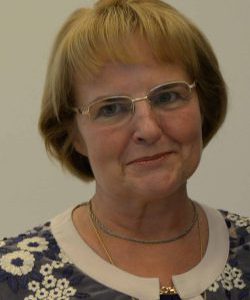
Computational Electromagnetics in a Material World
Malgorzata Celuch, QWED Sp. z o.o
Abstract: Computational Electromagnetics (CEM) software has become an indispensable tool in microwave engineering and research. While in many cases a CEM model so faithful to the physical reality that it allows virtual prototyping, in general a CEM-based design can only be as good as the materials’ data fed into the model. However, the worlds of microwave and material technologies traditionally interacted to a very limited extent. This presentation is designed to bring a “material aspect” into the overall picture of the state-of-the-art CEM tools and applications. It is motivated by the authors’ three decades of experience, first, in the development of CEM algorithms during their golden age, and then, in adapting them to the practical needs of microwave materials processing. The authors relevant contributions are presented for, e.g., conformal modeling of boundaries, lossy and temperature-dependent materials, field singularities, and bilateral coupling of EM and thermal processes. This part of the talk is illustrated with domestic oven benchmarks (used for evaluating the accuracy and efficiency of FDTD and FEM software) as well as examples from other technologies (microwave chemistry, asphalt repair, waste recycling). The second part of the talk concerns CEM applications for the enhanced characterization of materials at use conditions. It is illustrated with the measurement techniques for 1-170 GHz frequencies, developed by the author’s company. First, a brief review is provided of popular instruments based on cavities, dielectric split-post and single-post, and Fabry-Perot Open Resonator. Then, most recent research results are highlighted, where the use of CEM is conceptually fundamental. These include 2D scanning scanning setups (for detection of inhomogeneities in electronic and energy materials) and Q-Choked resonators (where the choke removes parasitic modes of a resonator, thereby extending its sensitivity and applicability). The talk finishes with a virtual tour of the author’s laboratories and outlook to the future.
Speaker's Bio: Malgorzata Celuch received M.Sc. (Hons.) and Ph.D. (Hons) degrees from the Warsaw University of Technology (WUT), Poland, in 1988 and 1996, respectively. Until 2017 she held academic positions at WUT’s Institute of Radioelectronics and Multimedia Technology, where she continues to co-supervise doctoral students. In 1996, with a vision to commercialize her research results, she co-founded QWED Sp. z o.o., a high-tech SME. Dr. Celuch led QWED as Vice-President / CTO (1996-2017) and President / CEO (2017-2025). Under her leadership, QWED became a renown vendor of two product lines: simulation software of QuickWave series (electromagnetics and multiphysics) and simulation-driven techniques for microwave material measurements. The products were acclaimed by hundreds of clients of five continents. QuickWave was awarded with the European Information Technology Prize, while recent hardware solutions were recognized on the Europear Horizon Innovation Radar. Dr. Celuch is author of 180+ scientific papers and 7 monograph chapters (h-index 18, 1300+ citations), and recipient of 10+ awards for excellence. She led R&D projects, industrial and co-funded under the European Horizon Frameworks, exploring synergies between computational modeling and materials’ characterization, with recent interest around 5G/mmWave frequencies (EUREKA-Eurostars 5G_Foil) and energy materials (H2020 MMAMA and NanoBat, M-ERA.NET I4Bags). She contributes to several professional organisations (IEEE, EuMA, iNEMI, IMPI, and European Material Modelling Council). Since 2006 she serves as an expert for the European Commission research and innovation programs. In 2025, Dr. Celuch retired from managerial roles and, while remaining with QWED as advisor, she now focuses on mentoring and volunteering activities, mainly via IEEE. She is elected AdCom member of IEEE MTT-S (2024-206), Chair of MarCom and member of other committees (including Publications, Meetings & Symposia, SIGHT). She serves as Associate Editor and Steering Committee member for IEEE JMMCT. She is Vice-Chair of MTT-1 and member of MTT-17.
Monday 10:43
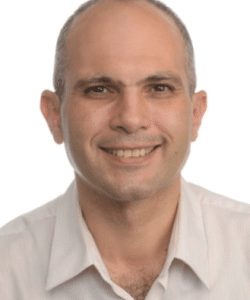
Multi-Functional Filtering Components for High Power Applications
Mohamed M. Fahmi, Defence Research and Development Canada; Electrical & Computer Engineering Department, University of Waterloo, Canada
Abstract: In this talk we will discuss all aspects of the design of multi-functional filtering components for high power applications. We will discuss the importance of embedding filtering functions within other passive microwave components employed in high power systems such as radial power combiners, or coupler-based power combiners. These include Gysel couplers, and couplers that have quadrature or rat-race characteristics. Multi-functional filtering components have attracted a lot of attention due to their promising potential. The integration of several functions within a single device is an ascending trend addressing the Size, Weight, and Power, (SWaP) paradigm. Such designs simplify system architecture and reduce component count. This, in turn, has very practical advantages ranging from simplifying assembly, streamlining quality control, eliminating phase and amplitude imbalance as well as reducing component variations. All this translate into shortening the production cycle and reducing production costs. Many advanced designs have been reported in the last decade on combiners with filtering characteristics, covering both theoretical synthesis and practical technological realization. We will start by discussing different classical types of combiners, such as radial combiners, travelling wave combiners, and corporate combiners. We will then discuss the subject of high-power filters. Next, we will discuss how to integrate different filtering functions within the different types of power combiners. Accurate EM modeling of the components will be also discussed. We will then discuss how to use coupled resonator networks to realize a variety of forward, backward, in-phase, quadrature and rat-race filtering couplers. We will extend this approach to multi-way multi-section filtering couplers based on lattices of coupled resonators. Throughout this discussion we will examine available synthesis methodologies, and trade-offs in terms of the available technological realizations of different components. Experimental results will be shared for waveguide filtering radial combiners, ridge waveguide-based filtering couplers, and coaxial-resonator based filtering combiners as well.
Speaker's Bio: Mohamed M. Fahmi (S'05–M'09-SM'23) received B.Sc. (with Honors) in Electronics Engineering from Mansoura University, Egypt in 1999. The MS degree in Electrical Engineering from Howard University, Washington DC, USA in 2003, and the Ph.D. degree in Electrical Engineering from the University of Maryland, College Park, USA in 2007. He worked as a post-doctoral researcher at the department of Electrical and Computer Engineering at the University of Maryland from January to July 2008, and as a post-doctoral fellow at the department of Electrical and Computer Engineering at the University of Waterloo, Canada from September 2008 to January 2012. He worked as a microwave Engineer, Senior Microwave Engineer and as a Manager of Passive Component Engineering at Nanowave Technologies Inc. in Etobicoke, Canada from February 2012 to February 2017. He worked as a Senior System Engineer, Radar Specialist at General Dynamics Mission Systems Canada, in Ottawa, Canada from February 2017 to February 2018. In February 2018 he joined Defence Research and Development Canada as a Group Leader, Radar Technology and Engineering. Dr. Fahmi is an adjunct Associate Professor at department of Electrical and Computer Engineering at the University of Waterloo, Canada. His current research interests include CAD of microwave devices and systems.
Monday 11:16
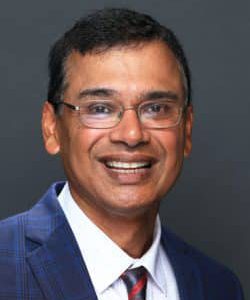
Multifunctional Oxide Thin Film Devices for 5G/6G Applications
Guru Subramanyam, Department of Electrical & Computer Engineering, University of Dayton
Abstract: This talk begins with an introduction to 5G/6G, and practical challenges in implementing 5G/6G technology. Integration of advanced multifunctional materials enables new functionalities for RF/microwave circuits for 5G/6G communication systems. This talk will introduce two thin film multifunctional oxide technologies. One is a thin film Barium Strontium Titanate (BaxSr1-xTiO3-henceforth BST) based variable capacitor (varactor) tuning element for reconfigurable microwave circuits and second is the use of phase change thin film Vanadium Dioxide (VO2) for reconfigurable intelligent surfaces (RIS). Details of the advanced thin film processes for the integration of BST thin film varactors and VO2 devices, their unique electromagnetic properties and their demonstrated microwave applications will be presented.
Speaker's Bio: Guru Subramanyam is currently a Professor and School of Engineering Faculty Fellow in the Department of Electrical and Computer Engineering, at the University of Dayton. He received his PhD (1993) and MSEE (1988) degrees in Electrical Engineering with specialization in Microelectronics from the University of Cincinnati, following his BE degree in Electrical and Electronics Engineering from the PSG College of Technology, (then affiliated with University of Madras) in 1984. He has published over 175 refereed journal and conference papers in the areas of thin film materials and devices and holds eight patents. His current research involves oxide thin films including reconfigurable microwave circuits, phase change materials, and memristors for neuromorphic computing. He has been collaborating with the Air Force Research Laboratory (AFRL) since 2000. His work to date has been funded by NASA, AFRL, AFOSR, NSF, DARPA, NSTXL (Microelectronics Commons Program), and several companies including Lockheed Martin, Northrop Grumman, Rockwell Collins, and Indiana Microelectronics. His research funding at the University of Dayton exceeds $10M to date. Professor Subramanyam won the 2008 Alumni Award for Scholarship at the University of Dayton, and 2007 IEEE Dayton section Harrell Noble Award for his achievements in electronic devices. In 2010, he was recognized by the Affiliate Societies Council of Dayton as one of the outstanding engineers/scientists in the Dayton area in the category of research. This award included a proclamation from the Ohio State Assembly. In 2013, University of Dayton opened the Center of Excellence for Thin-film Research and Surface Engineering (CETRASE) under Professor Subramanyam’s leadership. In 2024, he was recognized as a Distinguished Professor and the School of Engineering Faculty Fellow at the University of Dayton. He is a Senior Member of IEEE and currently serving as the Region2 coordinator for the Microwave Theory and Technology Society (MTT-S).